She's Not Wrong. She's Just Not Talking To You.
Can we talk about something? Because there is a whole conversation happening right now about work, ambition, and what it actually takes to succeed and a lot of what's being said is being received by women who it was never actually designed for.
Emma Grede is trending. She went on the Keke podcast, girl, to promote her new book, Start With Yourself, and a clip about work from home culture has been making the rounds.
Her take: visibility matters, and being out of sight means being out of mind when promotion season comes. "You are not in line for the same promotions or pay increases when you are out of sight.”
I can't say that's wrong. Proximity bias is real. And if you're in a corporate environment trying to climb, the politics of being seen are very much a thing. I've experienced it myself. I was remote, I was almost laid off, and from what I understand it had nothing to do with my work as it did with my location. What kept me wasn't showing up to the office every day. It was the professional relationships I had built over time. The people who knew my work, knew my value, and made it a point to say so when it counted, whether or not I was physically in the room. Visibility, yes. But the kind that comes from the depth of your relationships, not just your presence on a floor plan.
And that’s where I’m going to address this from… and because it's Emma Grede, and that context matters.
Disclaimer: I'll be honest, I'm not a regular listener of her podcast, Aspire. Not because of the content, I've caught bits and pieces and the conversations are genuinely…okay. But she interrupts her guests constantly and I just can't do it. It’'s a personal trigger and I know it exists. So, I come to this with one foot in and one foot out. Now that that’s out the way…
From what I’ve learned about Emma’s story, is that she has indeed built her empire through proximity. Absolutely. But let's be specific about what kind of proximity. She met her husband at work. He was her boss. And through that relationship she gained access to the Kardashians, which became the launchpad for SKIMS and Good American. Please note, I am NOT saying she isn't talented, because she clearly is. She's sharp, business-savvy, and has contributed to building real brands. But when she's telling women to get in the office because that's where opportunity lives... it's worth asking, is it showing up every day that changed her trajectory, or was it who she was connected to?
Because those are two very different things.
And so now she is doing her rounds on Keke, and The Breakfast Club, chile, to promote her new book, Start With Yourself. It's described as a no-nonsense guide to success on your own terms, covering money, leadership, and the mindset blocks that hold women back.
And look, I only know about any of this because it's trending. That's literally it. I wasn't tuned in, I wasn't looking for it, it just found me because the internet was loud about it.
And that what it is.
The audience for her podcast, Aspire, is entrepreneurially minded women who are already building, already in motion, already thinking about their next move. That's a very specific person with a very specific set of priorities. She probably isn’t commuting to a 9-to-5 with the radio on. The woman listening to Keke on her way to work or catching the Breakfast Club in the morning is probably not the same woman mapping out her Q3 business strategy. These are different women with different realities, and advice that works for one does not automatically translate to the other. It was a very pointed message broadcast to the wrong audience.
So the question isn't just whether the advice is good. It's whether the advice is for you. And when the packaging doesn't match the audience, that's a brand identity problem as much as anything else. All publicity isn't always good publicity when it alienates the very people you're trying to reach.
That's the conversation about Emma Grede. But there's a bigger one underneath it, and it's the one that's actually about you.
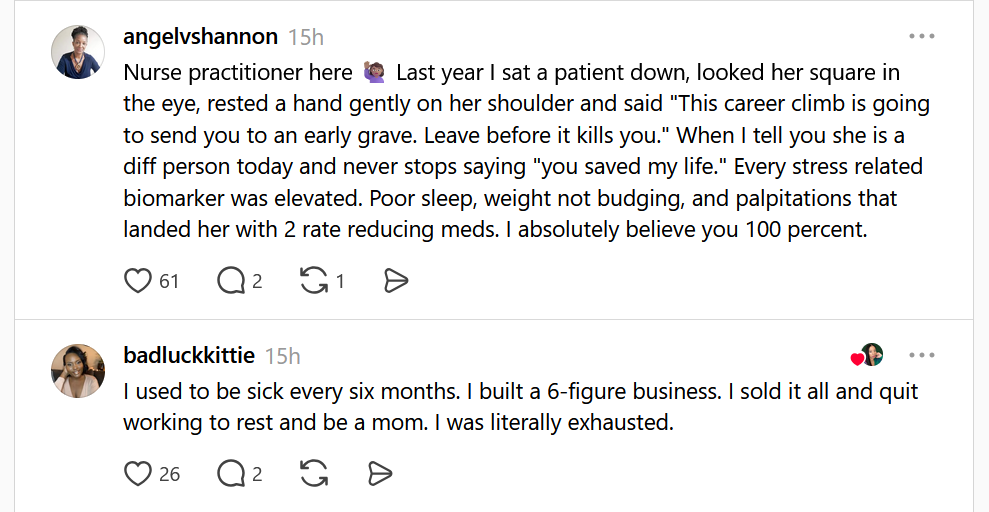
There is a Thread circulating of women sharing what chasing that ladder actually cost them. Hair falling out. Adrenal fatigue. Autoimmune flares. Anxiety that doesn't clock out.
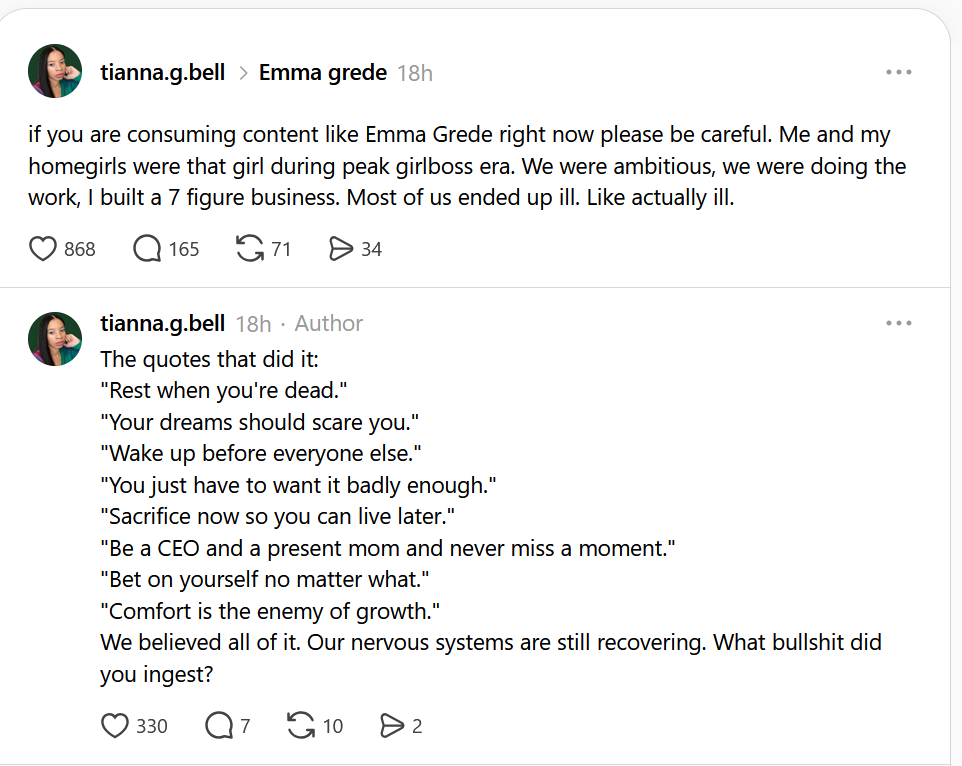
And this isn't dramatic, it's documented. Burnout rates are high across the board. In 2024, 52% of employees overall reported feeling burned out, with women reporting at 59% and men at 46%.More than half of women in leadership specifically say they feel constantly burned out. And a 2021 study led by Drexel University's Dornsife School of Public Health found that women who experience social strain in high-stress careers have a 21% increased risk of heart disease. Your body is keeping score whether or not your work calendar is.
A 2024 survey found that 80% of workers between the ages of 27 and 42 said hustle culture leads to burnout or health issues. Across every other age group measured, more than half said the same. This is not a fringe take. This is the majority of working people saying something about the way we've been told to operate isn't working.
Here's the other thing nobody says enough: women are not the same as men. And I don't mean that in a soft, handle-with-care way. I mean it biologically, hormonally, structurally. The sun and the moon both light the sky, but they do it completely differently. The moon has phases. The sun rises and sets. They are not the same just because they both show up. Women's bodies operate on a roughly 28-day cycle, and chronic stress disrupts that in ways that compound over time. Pushing through the way hustle culture demands is not a neutral act for a woman's body.
Now, women like Emma Grede exist and they are, seemingly, thriving on their terms. Rachel Rodgers, who wrote We Should All Be Millionaires, has a similar mindset, and plenty of women swear by that book too. I picked it up. But couldn't finish, it was so misaligned with who I am and my values, priorities, and how I define legacy. That doesn’t make it wrong. It makes it not mine.
And that's the thing.
One clip, one book, one sound bite should never be what makes you feel behind or out of alignment with your own values. The woman who wants to be in the office, climb the ladder, build the empire, and structure her life around that ambition is not more or less right than the woman who wants to build quietly, protect her peace, be home for for the kids, and grow in a way that doesn't cost her her health or her family. Both are valid. Neither is the blueprint for the other.
What I want for every woman who reads this is to be so clear on who she actually is that she can move through the noise without losing herself in it. Not who the internet told them to be, not who the trending sound clip is telling them to aspire to, but who she is at her core. Because that kind of clarity shows up in how you carry yourself, how you make decisions, how you build a business or a brand, and how other people receive you. Confidence that comes from genuine self-knowledge is a different thing entirely than confidence that's performed because someone told you to have it.